
Stop Loss Portfolios
A predefined exit rule, and a rule for getting back in.
Why this exists
In 2020, the S&P 500 fell 30% from its February 19 record high in just 22 trading days. According to Bank of America Securities data, that was the fastest decline of that magnitude in history. The second, third, and fourth fastest all occurred during the Great Depression era, in 1934, 1931, and 1929.
Declines can happen faster than anyone can react to them. That's the case for deciding in advance.
How the rule works
Three portfolios are available: Conservative, Moderate, and Aggressive. Each carries the same trigger mechanism, which has two halves.
Getting out. If the S&P 500 closes 12% or more below its most recent peak, the portfolio sells its equity positions and moves into bonds.
Getting back in. If the decline from peak to trough was less than 30%, the buy-back triggers once the S&P 500 recovers 50% or more from its low. If the decline exceeded 30%, the buy-back triggers considerably sooner after the low is reached.
Both halves are written in advance. Neither depends on anyone's read of the market at the time.
A stop-loss rule has a tradeoff, and it's worth stating plainly. The trigger can fire on a decline that reverses shortly after, which means selling near a short-term low and buying back at a higher price. That's called a whipsaw, and no rules-based strategy avoids it entirely.
The rule isn't built to be right every time. It's built to be consistent, and to remove the two decisions investors most reliably get wrong: when to get out of a serious decline, and when to get back in.
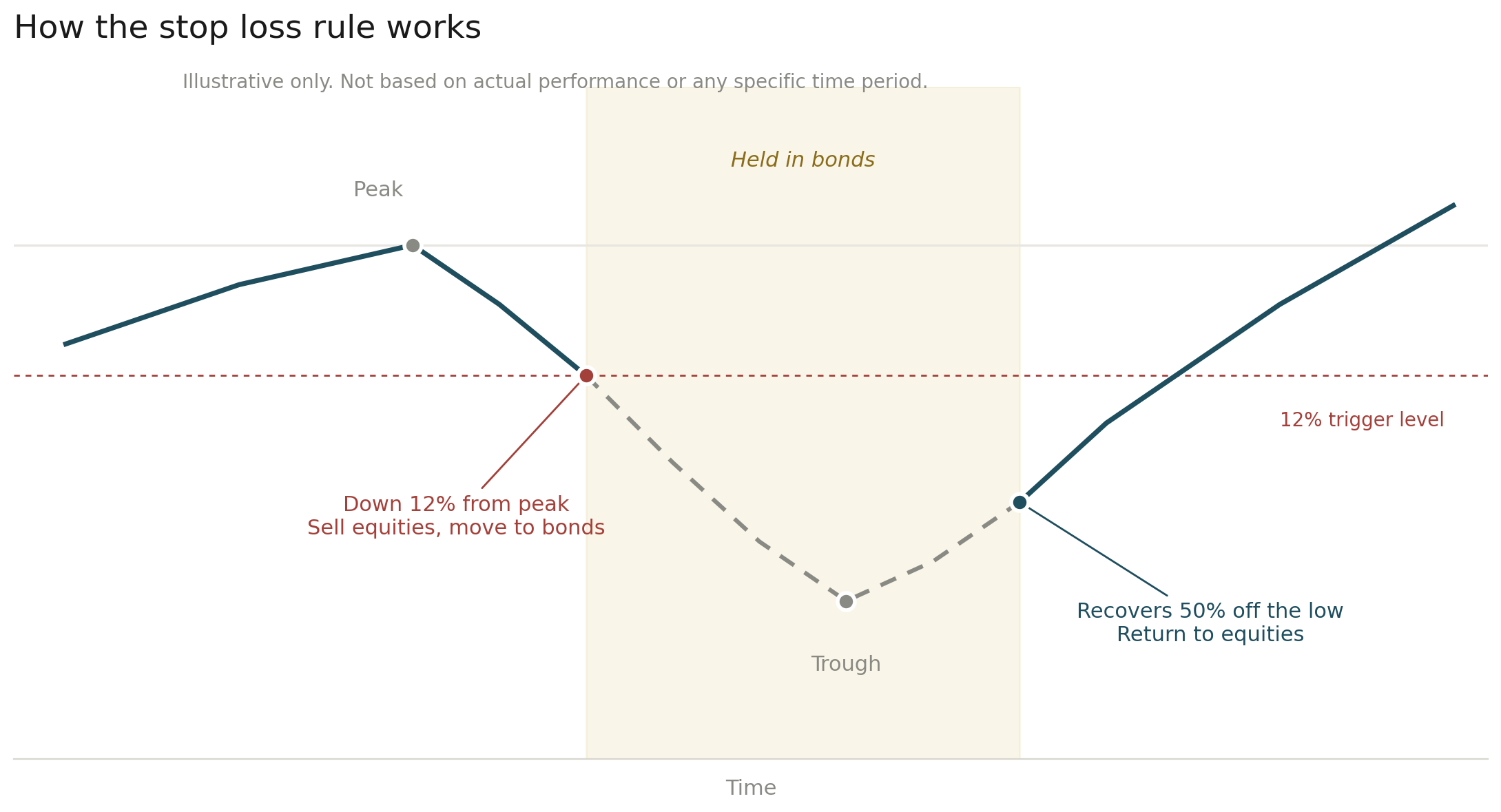
The Part Most Investors Get Wrong.
Selling is only half of it. In a serious correction, many investors hold too long, take the loss, and then wait too long to reinvest, missing the recovery. Two decisions, both made under pressure, both made badly.
A stop-loss rule with a defined buy-back addresses both. The exit is decided before the drawdown. So is the re-entry.
The equity side
The equity portion can be built with an equal-weight ETF, a market-weight ETF, or a Nasdaq-100 ETF, depending on the exposure that fits your portfolio.
Who it fits
Investors who want equity exposure but can't afford a deep drawdown, particularly those near enough to retirement that recovery time is a real constraint.